

Kvarner isn’t just a stop between Istria and Dalmatia—it’s a region with its own identity, shaped by winds, stone, and a slower rhythm of life. It feels more raw and authentic than the polished tourist zones further south.
🌍 The feeling of the place
When you arrive in Kvarner, the first thing you notice is space.
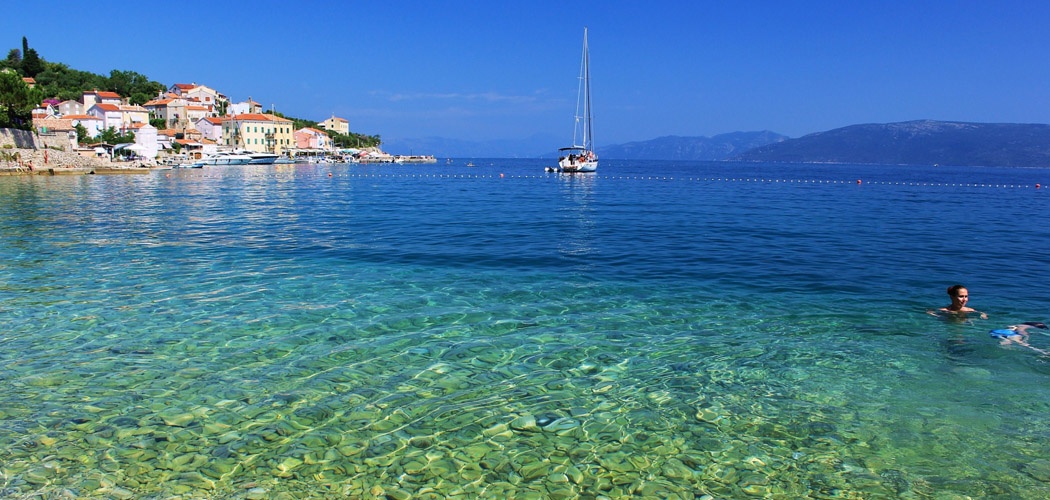
The sea is wide, often deeper blue than in southern Croatia. The islands are not packed tightly together—there’s distance between them, and that creates a sense of openness. You don’t feel “inside a tourist corridor,” but rather in a natural maritime landscape.
Behind the coast rises the massive wall of Velebit, which gives the whole region a dramatic backdrop. On clear days, you see mountains, islands, and open sea all at once.
🏝️ Life on the islands
Each island in Kvarner feels like a separate world, not just a variation of the same theme.
On Cres, villages are quiet, sometimes almost empty outside summer. You’ll find stone houses, narrow streets, and silence broken only by wind or cicadas. Some bays are only accessible by boat—no roads, no beach bars.
Cross to Lošinj, and suddenly everything becomes greener and softer. Pine forests reach down to the water, and the air smells different—resin, salt, and herbs. Towns like Mali Lošinj feel alive but never overwhelming.
On Rab, the atmosphere changes again—warmer, lighter, more Mediterranean. Sandy beaches and shallow water make it feel almost like a different country compared to rocky Croatia.
Then there’s Pag, which looks almost unreal. The landscape is bare, shaped by strong winds, with very little vegetation. It’s harsh, minimal, and strangely beautiful.
🌬️ Wind as a defining element
Kvarner is one of the few places where wind truly shapes daily life.
The bura (cold northern wind) can appear suddenly, clearing the sky and turning the sea into sharp, white waves. It gives the region that crisp, high-visibility look—mountains seem closer, colors sharper.
Locals respect it. Sailing routes, fishing, even daily plans often adapt to the wind.
🚤 What sailing feels like here
Sailing in Kvarner feels more “real” and less staged.
You don’t just hop from crowded marina to marina
You often anchor in quiet bays with no infrastructure
Distances are short, but conditions can change quickly
A typical day might be:
Morning: calm water, glassy sea
Afternoon: steady maestral wind, perfect sailing
Evening: complete silence in a hidden bay
Compared to Split or Dubrovnik, it’s less about nightlife and more about the sea itself.
🏙️ Mainland contrast
On the mainland, towns like Opatija bring a completely different tone.
Opatija feels elegant and historical—old villas, seaside promenades, a kind of Central European charm by the sea. It’s not rustic; it’s refined, almost nostalgic.
Meanwhile, Rijeka is more urban and real—a working port city, less polished, but culturally alive.
🍽️ Food culture (more “local” than trendy)
Food in Kvarner is less about presentation and more about quality of ingredients.
You’ll find:
extremely fresh seafood (especially scampi)
simple grilled fish with olive oil
lamb cooked slowly, often from island farms
strong, straightforward flavors
And of course Paški sir—a hard cheese shaped by the salty winds of Pag.
🧭 The overall character
If you compare regions:
Istria → refined, гастрономия, Tuscany vibe
Dalmatia → iconic, lively, tourist hotspots
Kvarner → balanced, natural, authentic
It’s a place where:
nature still dominates over tourism
you can find silence even in high season
the experience feels less curated and more real
🧠 Simple summary
Kvarner is for people who want:
sailing without crowds
islands with different personalities
a mix of comfort and wilderness
and a coastline that still feels untouched in many places
If you want, I can go even more practical:
exact anchor spots + marinas (with coordinates)
best routes for catamarans (Lagoon 40–55 etc.)
or which island fits your business idea (charter / real estate / tourism)**